
Beyond New Year’s resolutions – how to set goals you’ll actually keep

Beyond New Year’s resolutions – how to set goals you’ll actually keep
 Wellness Cloud Team
 |
Getting your Trinity Audio player ready...
|
Research suggests that people who write down their goals are 42% more likely to achieve them than those who don’t. That single statistic is a useful reminder that lasting change rarely comes from a burst of motivation – it comes from clarity, intention, and follow-through.
As the new year begins, it’s easy to default to familiar resolutions: get fitter, save more, be more productive. But many of these goals fall apart by February, not because we’re lazy or lacking willpower, but because we often zoom in too tightly on one area of life and forget the bigger picture.
If you want goals that stick, it helps to start with a different question: what needs attention in your life right now and why? From there, you can build goals that make sense for the season you’re in, rather than goals that look good on paper but don’t fit your reality.
Why balance matters more than a perfect plan
When people feel dissatisfied or restless, it’s often less about one thing being wrong and more about life feeling out of balance. You might be thriving at work but exhausted and disconnected at home. Or home life might feel so full-on that work becomes a source of stress and guilt. Sometimes self-care slips quietly down the list until you realise you haven’t properly rested, moved your body, or done anything just for you in weeks.
The challenge is that balance can feel vague – almost like an impossible standard. But balance isn’t a fixed destination or a perfect 10/10 across every category; it’s personal. What feels balanced for one person might feel stifling or chaotic to another. And it shifts over time: there will be periods when work takes priority, times when family needs you more, or seasons when your health or personal growth must move to the front of the queue.
The goal isn’t to ‘have it all’ at once. The goal is to make conscious choices about where your time and energy are going, so you feel more aligned with what matters to you.
A simple life audit that brings instant clarity
One of the most practical ways to understand what’s going on beneath your resolutions is to take a bird’s-eye view of your life. A straightforward tool for this is often called the Wheel of Life – a visual ‘audit’ that breaks life into key areas (for example: career, health, relationships, finances, friends, family, personal growth, fun/recreation, environment, spirituality, or community). You choose the categories that fit you.
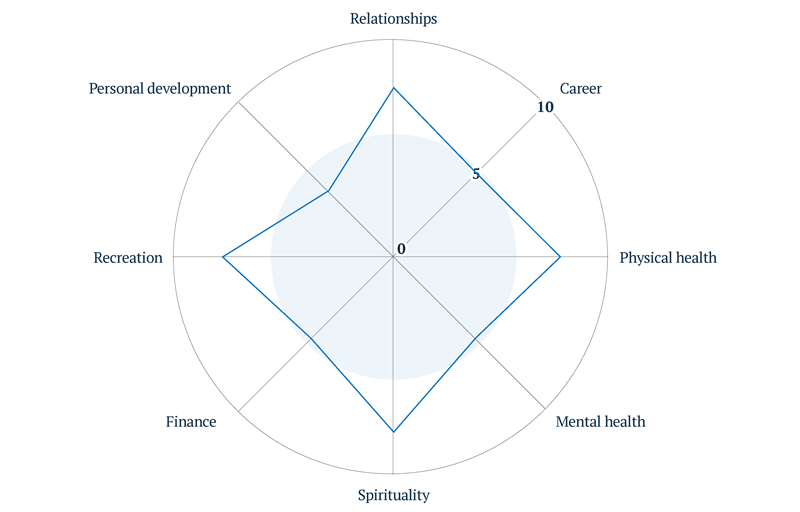
Here’s how it works:
- Create your categories. Pick 8 areas that reflect the main parts of your life right now.
- Score your current satisfaction. Rate each area from 0–10 based on how satisfied or fulfilled you feel today.
- Mark your ideal. Go around again and choose what you’d like each score to be – bearing in mind this doesn’t have to mean 10 in everything.
- Notice the gaps. The biggest insight often comes from seeing where your current reality and ideal don’t match.
This is where many people are surprised. You might realise you’ve been neglecting friendships, or that your environment is actually supporting you more than you gave it credit for. It can also highlight something important: a low score doesn’t automatically mean a problem. If an area isn’t a priority for you right now, it’s okay for it to stay lower. What matters is the gap between what is and what you want.
Turning awareness into a goal that’s doable
Once you can see your wheel clearly, choose one area to focus on first – the one that’s calling for attention, either because the gap is biggest or because improving it would lift everything else. Then ask:
- Why is this score lower than I’d like?
- What’s missing here: time, mindset, support, skills, rest, connection?
- What would genuinely improve this area – not in theory, but in real life?
From there, set a long-term goal using a simple structure many people find helpful: SMART goals: specific, measurable, achievable, realistic and time bound. A strong goal isn’t just inspiring; it’s workable. “Get healthier” is hard to act on. “Run 5K by June” is clearer.
But the real secret is what comes next: break it down into small, repeatable actions that build momentum without burnout. If your goal is about health, small steps could be a weekly run, a lunchtime walk, or food prepping on Sundays. If it’s about family time, it could be eating dinner together once a week, or putting a shared plan in place so weekdays feel less frantic.
Two things make follow-through more likely:
- Schedule it. Put the action in your diary like an appointment. If it isn’t planned, it’s easy for everything else to claim the space.
- Plan for obstacles. If your running buddy cancels, what’s your backup? If evenings get hectic, what’s the smallest version of your habit you can still do?
Motivation grows when you reward progress
One of the most overlooked parts of goal setting is celebration. Many of us achieve something and immediately move the goalposts: that wasn’t fast enough, I should do more next time. But rewards reinforce behaviour and keep motivation alive. Reward doesn’t have to be extravagant. It can be a moment of acknowledgement, sharing a win with someone, or treating yourself to something meaningful. The point is to recognise progress rather than dismiss it.
A final daily prompt can also help you stay grounded: “What’s the one important thing for me to do today?” When goals feel overwhelming, this question brings you back to what’s manageable now.
Resolutions often fail because they’re built on pressure and vague intention. Goals that stick are built on clarity, alignment and small steps repeated consistently. Start with the big picture, choose what matters most, write it down and then take one realistic action this week. That’s how change becomes something you live, not something you abandon.